You’re Not Failing Your Resolutions. You’re Addicted to Your Life.
Let’s stop calling it a motivation problem.
Most people don’t change because they’re not trying hard enough.
They don’t change because their current life is paying them.
That’s what addiction is: a repeated behaviour that delivers a payoff.
And here’s the part people hate because it removes the comfort blanket:
Nearly everyone is addicted to something – the common varieties include alcohol, drugs, porn, gaming, sugar, phones, soap operas. But I’m referring to the less commonly identified versions.
Familiarity and Identity
To the predictable emotional loops that come with “being me.”
Even if they complain about their life… they’re still addicted to it.
Because it still gives them something:
- certainty
- comfort
- distraction
- drama
- righteous anger
- “I’ll start tomorrow” relief
- victim benefits
- a story where it’s not their responsibility
And it gets worse:
You’re not only addicted to what your life gives you. You’re addicted to what it doesn’t give you.
Because what you don’t have becomes a payoff too:
- excuses
- permission to stay small
- reasons to blame others
- justification for staying stuck
That’s why change is rare.
Not because people don’t know what to do.
Because change threatens their supply.
So when you set a New Year’s resolution, you’re not negotiating with a goal.
You’re negotiating with an addicted identity that has rehearsed itself for decades.
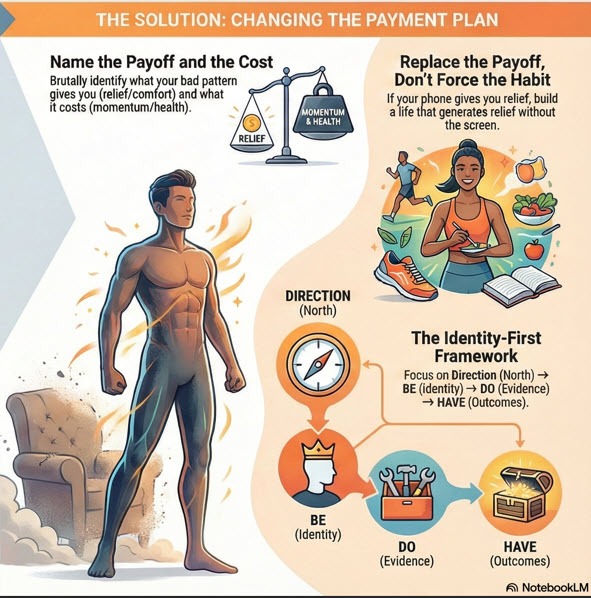
This is why the first step isn’t discipline.
It’s acceptance — not soft acceptance.
Let’s take an accuracy moment:
This is who I am right now.
This is what I do.
This is what it gives me.
This is what it costs me.
And yes — I’ve been choosing it.
And if I’m going to say that out loud about you, I’m going to say it about me too.
My name is Brydon Davidson. I’m an addict.
My old addiction wasn’t alcohol or drugs. It was relevance.
I was hooked on being useful to humans — not because I’m a saint, but because usefulness was my safest path to connection.
So I over-helped. I over-explained. I tried to cover every base. I tried to remove every friction point before it could become conflict. I told myself I was being generous — and sometimes I was — but underneath it was a quieter dependency:
If I can be undeniably valuable, I can’t be ignored.
That addiction made me carry responsibility that was never mine. It made me try to ‘save’ people who weren’t ready.
And it made my work heavier than it needed to be — so heavy that not much got shipped, because every piece had to be bulletproof, complete, unarguable… and safe.
I knew the truth even then: you can’t save humans unless they’re ready to save themselves.
But I hadn’t accepted what that truth demanded of me:
Stop rescuing. Stop chasing. Stop performing usefulness as a substitute for leadership.
And that’s why this matters: the same mechanism that keeps you addicted to your life… kept me addicted to mine.
The difference now is I’m choosing a new addiction on purpose.